Enterprise AI · Governance · Delivery

Based in Singapore

ANURODH KUMAR / AVP, TECHNOLOGY AT DBS

Building enterprise
AI systems.

My work spans enterprise GenAI and agentic AI platforms, grounded in around 15 years across banking, data and production engineering. I connect business priorities, architecture decisions and operational governance to help turn AI capabilities into dependable enterprise systems.

From models to systems to production. Secure, reliable and usable at scale.

~15 yearsBanking & technology
Banking → AIProduct and platform experience
Business + technologyConnecting priorities to delivery

01 / Experience & perspectives

From complex systems
to practical outcomes.

Enterprise delivery, AI adoption and the operating decisions that make systems dependable.

Featured perspective01

Alert-Bridge

Making AI signals operational.

Model access is only one part of an enterprise AI platform. Usage, failures and thresholds need a clear route to the people responsible for acting on them.

Alert-Bridge connects cloud monitoring with enterprise operations through policy management, event normalisation and consistent severity routing. The aim is clear ownership, timely action and controlled change across platforms.

  • Observability
  • Accountability
  • Operational governance
Explore the design decisions
Inside Alert-Bridge Problem, architecture and trade-offs

The problem

Useful telemetry can still leave an operational gap: who owns a signal, how does it reach them, and what should happen next? Alert configuration also needs to fit established production change controls.

The design

Separating signal collection, policy decisions and response workflows makes ownership clearer. Alerts carry enough context for an accountable owner to assess severity and act; policy changes follow a reviewed, auditable process. The technology choices depend on the environment.

The trade-off

A bridge adds a service to operate. Its value is a consistent integration point for policy management, severity routing and existing operations tooling. Retries, duplicate handling, least-privilege access and an auditable change process belong in that design.
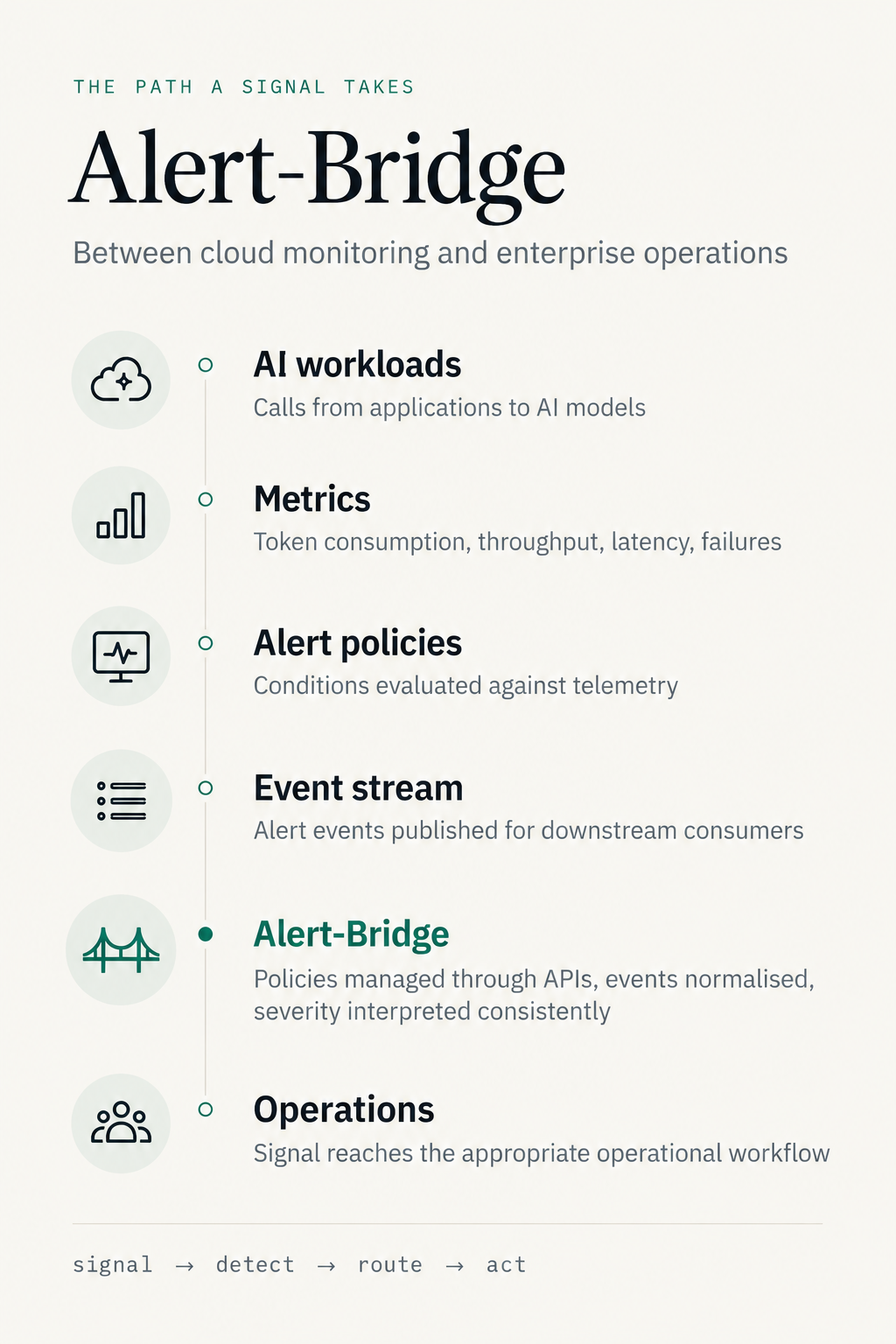
Alert-Bridge: AI workloads produce metrics evaluated by alert policies; an event stream carries alerts through Alert-Bridge to operations. Policies are managed through APIs, events normalised and severity interpreted consistently.View full-size diagram
Current / Enterprise AI02

Enterprise AI in practice

In my current role at DBS, I work on enterprise GenAI and agentic AI capabilities in a regulated environment. My scope spans platform architecture, integration, observability, governance and production controls. This gives me a practical view of the decisions and operating responsibilities that sit between an AI capability and dependable enterprise use.

  • GenAI & agentic AI
  • Cloud architecture
Earlier / Banking & data03

Turning data into insight

Earlier, as a technology lead and product owner in banking, I worked across customer insights and transaction data capabilities. The role connected business needs, data engineering and delivery priorities, with an emphasis on stakeholder alignment and useful customer outcomes.

  • Product ownership
  • Data engineering

02 / How I work

Business purpose.
Responsible delivery.

I work across business and technology perspectives to clarify priorities, make trade-offs visible and establish ownership through delivery.

01

Start with the purpose.

Understand who needs the capability and what should change for them. Let that shape the technical choices and the definition of success.

02

Design for the day after.

Think beyond the launch: how the system is observed, governed, supported and changed safely once people depend on it.

03

Create shared clarity.

Make trade-offs understandable, connect business and engineering perspectives, and give people a clear view of ownership and next steps.

03 / Perspectives

The questions behind
the implementation.

Questions that connect AI adoption, governance and everyday operating decisions.

01 / OPERATIONS

What happens after the model responds?

A useful answer is only part of the experience. I also want to understand the signals around it: latency, failures, consumption, quality and user feedback. The design question is how those signals inform a decision and who is responsible for it.

02 / AGENTIC AI

Where should autonomy stop?

Giving an agent another tool also gives it another way to affect a system. I think about access boundaries, evaluation, traceability and the points where a person should review a decision. These are useful constraints for designing something people can trust.

03 / DELIVERY

Can the team explain the trade-off?

An architecture decision becomes more useful when people understand why it was made. Making the alternatives, constraints and operational consequences clear helps a team move forward together—and revisit the decision when the context changes.

Continue the conversation on LinkedIn (opens in a new tab)

04 / A little about me

Grounded in experience.
Still curious.

My career has taken me from enterprise integration and banking platforms to data products and enterprise AI.

That progression shapes how I work: stay close enough to the engineering to understand the constraints, and step back far enough to see the customer, the team and the operating environment.

Based in Singapore, I’m interested in how organisations turn AI ambition into useful, responsibly governed capabilities. I’m currently pursuing the part-time MSc in Artificial Intelligence & Innovation at the National University of Singapore (NUS), extending my perspective on AI adoption and innovation. My earlier qualifications include a B.Tech in Computer Science and Engineering and a Post Graduate Diploma in Data Analytics from IIIT Bangalore.

Let’s connect

Good conversations
move things forward.

Enterprise AI adoption, governance, or connecting business and technology.
I’m always interested in a thoughtful exchange.

Connect on LinkedIn (opens in a new tab)